
Probiotics in Allergic Skin Inflammation Treament in Children
There is a particular emphasis on the benefits of supplementing probiotics in preventing and treating allergies in children. The Food and Agriculture Organization (FAO) and the World Health Organization (WHO) define probiotics in allergic Skin Inflammation as “live microorganisms that, when administered in adequate amounts, confer health benefits on the host” [1]. Several probiotics are currently available on the market. However, not all bacterial strains can be used as probiotics. Probiotics need to have some basic characteristics: they should originate from humans, be inherently non-pathogenic, withstand external processing as well as stomach acid, adhere to the intestinal mucosa, produce antimicrobial substances, regulate immune responses, and impact human metabolic activities [2]. Numerous studies have assessed the potential activities of probiotics in preventing and treating various conditions in humans, including allergies and allergic skin inflammation.
Allergic Skin Inflammation in Children
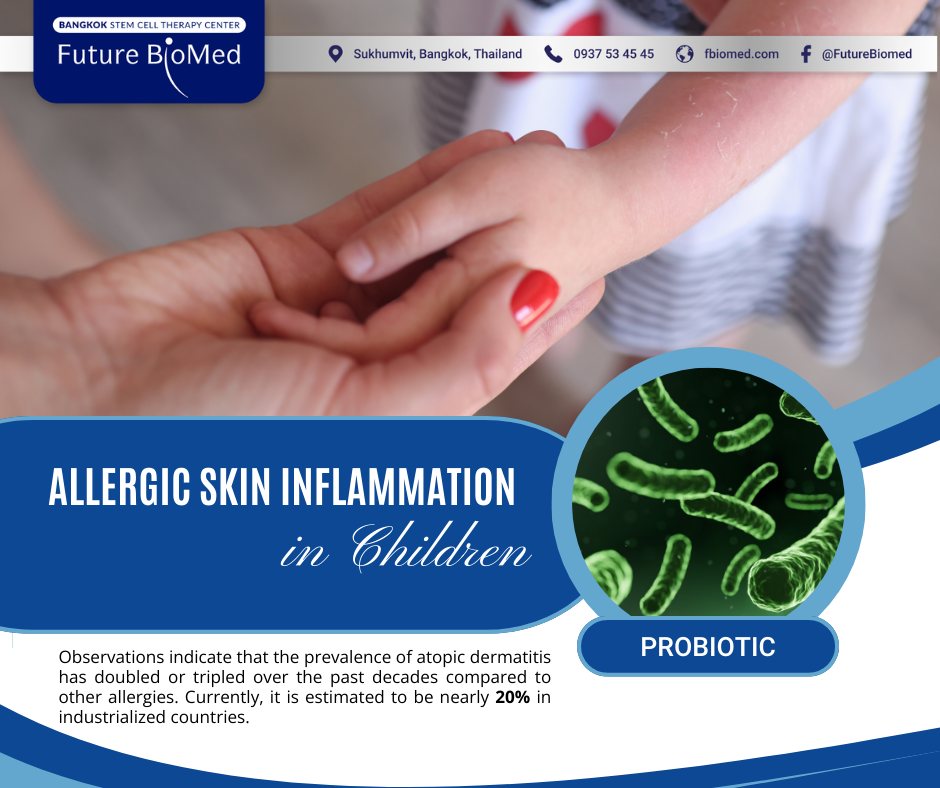
Atopic dermatitis (AD) is a common skin condition that often begins in childhood. The cause of atopic dermatitis (AD) is believed to result from a complex interaction between genetic and environmental factors. Both factors play a role in determining the predisposition and development of the disease [3]. Observations indicate that the prevalence of atopic dermatitis has doubled or tripled over the past decades compared to other allergies. Currently, it is estimated to be nearly 20% in industrialized countries [3]. The first hypothesis explaining the increasing prevalence of allergic diseases is called the “hygiene hypothesis.” It suggests that the risk of developing allergies is inversely related to conditions and hygiene standards, such as living in less crowded places, regular vaccinations, and widespread use of antibiotics, all contributing to reducing children’s exposure to pathogens, suppressing Th1-controlled immune responses, and favoring Th2-mediated immune responses in infants. This latter predisposes them to the development of allergic diseases.
Probiotics Applications in Preventing and Treating Allergic Skin Inflammation in Children
Prevention and Treatment Methods for Allergic Skin Inflammation in Children
Currently, allergic skin inflammation often lacks a definitive cure, and once it progresses severely, it can significantly impact daily life, causing physical and mental discomfort to the affected individuals. In clinical settings, healthcare facilities often recommend methods to alleviate symptoms and extend the time for the immune system to self-regulate when handling cases of allergic skin inflammation, providing relief to the patients. Moisturizing the skin is a common treatment method for mild cases and is one of the approaches used in treating moderate to severe cases. Additionally, doctors sometimes combine the use of first-generation antihistamines before bedtime to provide soothing effects, improve sleep, and occasionally reduce itch. The use of corticoids is also considered a complementary therapy, with patients applying corticosteroids topically twice a day when necessary; systemic corticosteroids are rarely required and depend on the age of the child and the area being treated [5]. However, in the current era, the methods to alleviate patient discomfort and support disease treatment, as mentioned, have several limitations and various side effects, such as the sedative effects of antihistamines and poorly understood benefits, and the misuse of corticoids leading to severe health complications and increased disease flare-ups. Moreover, the condition may worsen without timely and proper implementation of coordinated measures, leading to secondary skin inflammation, skin infections, and bacterial infections.
Some experts have suggested alternative treatment approaches, including using traditional medicines or herbs to minimize side effects. However, studies on dietary supplements (fish oil, zinc, vitamins, and sunflower oil) have not provided convincing evidence of improving allergic skin inflammation, even though these supplements seem safe [6,7,8]. Traditional medicine-based methods require thorough research evaluation to provide an objective assessment of their efficacy in reducing and preventing allergic skin inflammation in young children.
Probiotics for the Prevention and Treatment of Allergic Skin Inflammation in Children
Another hypothesis has emerged more recently, which suggests that by stimulating the patient’s gut microbiota and exposing them to symbiotic microorganisms or specific bacterial strains, certain immune system responses can be regulated to prevent the development of allergies [9]. By activating innate immunity and responding to continuous stimuli from developing symbiotic microorganisms, the maturation of the gut mucosal immune system and the development of the gut microbiota in the postnatal period occur. A lack or insufficient stimulation of microorganisms results in reduced intestinal surface area, altered enzyme patterns, mucosal barrier changes, and IgA system changes [10]. This gut microbiota imbalance increases Th2-directed immune responses in infants, creating favorable conditions for allergy development. Some studies indicate that the gut microbiota imbalance in allergic children is caused by increased clostridia and decreased bifidobacteria invasion [11]. If an imbalanced gut microbiota conditions the development of allergies, probiotics can be beneficial due to their ability to balance the gut microbiota, restore normal intestinal permeability, improve the immune barrier function of the intestine, and regulate the reduction of pro-inflammatory cytokine production.
Furthermore, the effects of probiotics on allergies are related to stimulating Toll-like receptors (TLRs). Intestinal mucosal epithelial cells create various recognition receptors to identify microbial antigens, also known as pathogen-associated molecular patterns (PAMPs). One class of these receptors is TLR, which stimulates TLR with different PAMPs to produce T-cell differentiation. In 1997, for the first time, a Finnish group showed a significant improvement in atopic dermatitis (AD) in infants after probiotic supplementation. Since then, researchers have published 19 trials on AD treatment, along with some meta-analyses and evaluations, but the current results and conclusions lack convincing evidence. Majamaa and Isolauri [12] studied a group of infants with AD. Breastfeeding mothers supplemented Lactobacillus rhamnosus LGG (LGG) to 11 infants allergic to breastfeeding. This trial showed a significant improvement in the SCORAD (Atopic Dermatitis Assessment Tool) after 1 month in the probiotic group. Three years later, Isolauri [13] randomly selected 27 breastfed infants with allergies using LGG/Bifidobacterium lactis Bb-12 or a placebo for 4 weeks. An assessment two months later demonstrated a significant improvement in SCORAD in the probiotic groups. In 2005, Weston et al. [14] experimented with 53 children with moderate to severe AD to evaluate the efficacy of Lactobacillus fermentum. The results showed a beneficial effect on improving the extent and severity of AD after 8 weeks of supplementation.
In contrast, other trials focused on supplementing a single strain, failing to confirm the positive effects of probiotics in AD treatment. Brouwer [15] randomly selected 50 infants with AD to receive Lactobacillus rhamnosus/Lactobacillus GG or a placebo in whey for 3 months. The results showed no significant change in probiotics for SCORAD, sensitivity, inflammatory parameters, or cytokine production. In the same year, another research group confirmed the unfavorable effects of probiotics on clinical symptoms, combined corticosteroids and on-site antihistamine use, immune parameters, and patient health with Lactobacillus rhamnosus GG in 54 infants with moderate to severe disease. Although there is a wealth of data, reviews, and published meta-analyses, they do not clarify the role of probiotics in treating allergic skin inflammation in children.
Most of these reviews conclude that there is not enough evidence to recommend the use of probiotics to treat AD in children [10]. The majority of studies focus on children at high risk of allergies, with probiotics used 2-4 weeks before birth for pregnant women and after birth for infants aged 6-12 months. The most studied probiotic strain is LGG. Michail et al. [16] and Kalliomäki et al. [17] first assessed the preventive efficacy of LGG in a randomized controlled trial in a group of 132 children at high risk of allergies. Follow-up after two years showed a 50% reduction in AD frequency in children supplemented with probiotics compared to the placebo group. A similar study followed the same group of infants for 4-7 years to examine the protective effect of probiotics against AD development [18]. The preventive effect of LGG on AD was also demonstrated by Rautava in 2002, who evaluated efficacy in 57 high-risk children breastfed by mothers supplemented with LGG. In the supplemented group, the disease risk was 15%, while in the placebo group, it was 47% [19]. A publication in 2008 compared the effectiveness of two different bacterial strains, L. rhamnosus and Bifidobacterium animalis sub sp., in preventing allergies in children. At the age of two, only L. rhamnosus showed efficacy, while no effect was demonstrated for B. animalis. The reasons for the inconsistency in results may be due to the study design, different patient conditions (number, age, severity of the disease, sensitivity to allergens, presence of other allergies), probiotic dosage, supplementation time, use of a single strain or combination, and follow-up time as the most plausible explanations.
Therefore, for patients with the potential to be impacted in their daily lives by allergies, preventing the disease at each onset is crucial. Modern approaches often employ preventive measures to control infections and inflammation. However, as mentioned, achieving prolonged control may be challenging and does not eliminate the risk of infection or the potential side effects of medication. Numerous studies have assessed the potential effectiveness of probiotics in preventing allergies in general and atopic dermatitis (AD) in particular, demonstrating promising results. Additionally, trials are highly complex due to the changing trends in AD over time. Therefore, before recommending the use of probiotics for allergic skin inflammation in children, larger-scale studies and clear guidelines are necessary to determine the appropriate use of beneficial bacterial strains in clinical trials.
References:
- FAO/WHO working group. “Guidelines for the evaluation of probiotics in food.” FAO/WHO Working Group (2002): 1-11.
- Dunne, C., L. O’Mahony, L. Murphy, G. Thornton, and D. Morrissey. “O’Halloran.” Feeney M., Flynn S., Fitzgerald G., Daly C., Kiely B., O’Sullivan G., Shanahan F., Collins JK (2001).
- Boguniewicz, Mark, and Donald YM Leung. “Atopic dermatitis: a disease of altered skin barrier and immune dysregulation.” Immunological reviews 242, no. 1 (2011): 233-246.
- Williams, Hywel, Colin Robertson, Alistair Stewart, Nadia Aït-Khaled, Gabriel Anabwani, Ross Anderson, Innes Asher et al. “Worldwide variations in the prevalence of symptoms of atopic eczema in the International Study of Asthma and Allergies in Childhood.” Journal of allergy and clinical immunology 103, no. 1 (1999): 125-138.
- Galli, Elena, Iria Neri, Giampaolo Ricci, Ermanno Baldo, Maurizio Barone, Anna Belloni Fortina, Roberto Bernardini et al. “Consensus conference on clinical management of pediatric atopic dermatitis.” Italian Journal of pediatrics 42, no. 1 (2016): 1-25.
- Gu, Sherman, Angela WH Yang, Charlie CL Xue, Chun G. Li, Carmen Pang, Weiya Zhang, and Hywel C. Williams. “Chinese herbal medicine for atopic eczema.” Cochrane Database of Systematic Reviews 9 (2013).
- Bath‐Hextall, Fiona J., Claire Jenkinson, Rosemary Humphreys, and Hywel C. Williams. “Dietary supplements for established atopic eczema.” Cochrane Database of Systematic Reviews 2 (2012).
- Bamford, Joel TM, Sujoy Ray, Alfred Musekiwa, Christel van Gool, Rosemary Humphreys, and Edzard Ernst. “Oral evening primrose oil and borage oil for eczema.” Cochrane Database of Systematic Reviews 4 (2013).
- Björkstén, Bengt. “The intrauterine and postnatal environments.” Journal of Allergy and clinical immunology 104, no. 6 (1999): 1119-1127.
- Meneghin, Fabio, Valentina Fabiano, Chiara Mameli, and Gian Vincenzo Zuccotti. “Probiotics and atopic dermatitis in children.” Pharmaceuticals 5, no. 7 (2012): 727-744.
- Björkstén, Bengt, Epp Sepp, Kaja Julge, Tiia Voor, and Marika Mikelsaar. “Allergy development and the intestinal microflora during the first year of life.” Journal of allergy and Clinical Immunology 108, no. 4 (2001): 516-520.
- Majamaa, Heli, and Erika Isolauri. “Probiotics: a novel approach in the management of food allergy.” Journal of Allergy and Clinical Immunology 99, no. 2 (1997): 179-185.
- Isolauri, E. T. Y. E. S., Taina Arvola, Yelda Sütas, Eeva Moilanen, and Seppo Salminen. “Probiotics in the management of atopic eczema.” Clinical & Experimental Allergy 30, no. 11 (2000): 1605-1610.
- Weston, Stephanie, Anne Halbert, Peter Richmond, and Susan L. Prescott. “Effects of probiotics on atopic dermatitis: a randomised controlled trial.” Archives of disease in childhood 90, no. 9 (2005): 892-897.
- Brouwer, M. L., S. A. A. Wolt‐Plompen, A. E. J. Dubois, S. Van Der Heide, D. F. Jansen, M. A. Hoijer, H. F. Kauffman, and E. J. Duiverman. “No effects of probiotics on atopic dermatitis in infancy: a randomized placebo‐controlled trial.” Clinical & Experimental Allergy 36, no. 7 (2006): 899-906.
- Michail, Sonia K., Adrienne Stolfi, Thomas Johnson, and Gary M. Onady. “Efficacy of probiotics in the treatment of pediatric atopic dermatitis: a meta-analysis of randomized controlled trials.” Annals of Allergy, Asthma & Immunology 101, no. 5 (2008): 508-516.
- Kalliomäki, Marko, Seppo Salminen, Heikki Arvilommi, Pentti Kero, Pertti Koskinen, and Erika Isolauri. “Probiotics in primary prevention of atopic disease: a randomized placebo-controlled trial.” The Lancet 357, no. 9262 (2001): 1076-1079.
- Kalliomäki, Marko, Seppo Salminen, Tuija Poussa, and Erika Isolauri. “Probiotics during the first 7 years of life: a cumulative risk reduction of eczema in a randomized, placebo-controlled trial.” Journal of Allergy and Clinical Immunology 119, no. 4 (2007): 1019-1021.
- Rautava, Samuli, Marko Kalliomäki, and Erika Isolauri. “Probiotics during pregnancy and breastfeeding might confer immunomodulatory protection against atopic disease in the infant.” Journal of allergy and Clinical Immunology 109, no. 1 (2002): 119-121.